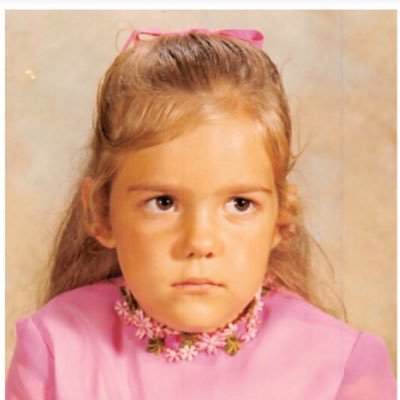
This is only open to those with a USA mailing address. Warning: For those who might be offended, the first chapter is sexually explicit but can be avoided, though there are some other brief mentions. For those who may all too easily dismiss and not read this memoir because the author is no longer a Christian, I believe that would be a mistake. There are things you could learn, especially what not to do in raising your child(ren). People leave the United Pentecostal Church all the time and some of those walk away from Christianity. If you would learn of the author’s childhood and what she endured, perhaps you would gain some insight as to why. Whether anyone chooses to believe it or not, the truth is that many preacher’s kids have walked away from the UPCI and their teachings.
The quotes in this article are taken from the book.
The United Pentecostal Church did not fool around when it came to outlining the rules. Daily life was defined by the forbidden, the church’s claws reached far beyond mandatory attendance twice on Sundays and once on Wednesday night. Maintaining a sense of separateness from the world was easily accomplished as our appearance announced our affiliation wherever we went. Strict decrees regarding entertainment and leisure activities also set us apart. Church members were not allowed to play or watch sports of any kind; card playing, television, and movies were absolutely forbidden, secular books and music severely limited. Association with non-church members, including neighbors and family, was discouraged. All of these parameters were designed to keep us saved and to ward off temptation and thus, Satan himself.
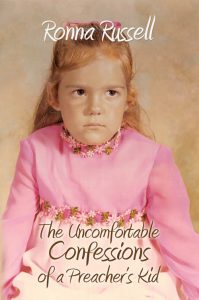 This is your chance to receive a new copy of The Uncomfortable Confessions of a Preacher’s Kid by Ronna Russell. Two copies will be given away. The book was released this month and is the author’s first. Selling for just under $18, there is a Kindle version available for only $5.99. Uncomfortable Confessions covers her upbringing in the United Pentecostal Church, of which her detached father, Donald Wayne Fisher, was a licensed minister.
Born in 1939, Don Fisher was very involved in the UPCI starting in his childhood and he held many positions throughout the years. He left home at the age of 14 to attend a UPC school that was hundreds of miles away. He was an assistant pastor at more than one church, a home missionary to Alaska, a pastor for a couple years and he worked in the Youth and Foreign Missions Divisions. He was the founder/editor of Word Aflame Publications, a vice-president of the Jackson College of Ministries (1976-1981) and a president of Conqueror’s Bible College (1981-1983). [These are two now defunct UPCI Bible colleges.] Don started the national Bible quizzing program and was responsible for coordinating the first international UPC convention in 1976. [Information taken from Heretics and Politics: Theology, Power, and Perception in the Last Days of CBC by Thomas Fudge.] I found it interesting to discover in Heretics and Politics that Don Fisher was a UPCI PK himself and that his father had not spent much time with him as a child because he “was too tied up in the church.” Unlike Don, his father later regretted this. The influence of Don Fisher on the United Pentecostal Church cannot be denied, yet at the same time his influence on his children was something quite different, so much so that Ronna has never missed him since his passing in 1995 as a result of AIDS.
Ronna, one of Fisher’s three daughters, shares her painful and lonely upbringing. She longed to belong and fit in somewhere and not feel suffocated by her father’s rules and control. She was starving for attention. Some people envy PKs, thinking they have life great, yet many do not and reading this memoir will cause you to reconsider such a thought. Not permitted to spend time with classmates, Ronna was also hindered in school as she was uninformed of world events and culturally unaware. It wasn’t enough for her to stay away from school classmates, she was also prohibited from spending much time with children from church. She had a childhood filled with fear of being lost, being left behind and fear of her father’s quick temper, never knowing when he might explode.
Their philosophy on childhood friendships was unusually strict, even by church standards. Free time before and after service was to be spent on my knees in the prayer room, not standing in the hall talking in clusters with other kids. Sitting by boys during church was forbidden, speaking to them at all prompted accusations of misbehavior from Daddy. I was not allowed to attend the church girl sleepovers, not old enough at ten or eleven when the invitations stopped coming. Asking to spend times with other girls was risky, especially if it was a spontaneous plan cooked up at church. Such a request might be met with rage, I never knew.
Ronna takes her readers on a journey through her childhood with all the changes as her family moved from place to place. Walk alongside her as she shares of Fisher’s involvement with the UPCI Foreign Missions Division and a family trip to South America, a trip that caused Ronna to be both scared and fascinated. Feel her struggles as the family moves to Mississippi so Fisher can work at the Jackson College of Ministries where her father’s fits of rage increase. There she witnesses something very disturbing that he does with a mouse. Next comes a move to Oregon where Fisher took over as president of the Conqueror’s Bible College. She starts gaining weight and deals with her father stealing money she earns at her part-time nursing home job. Under intense scrutiny and pressure, Fisher resigns froms CBC and moves his family to Sacramento, California where they become involved in an independent evangelical church and Ronna survives an ectopic pregnancy. It is while they are here that her father’s homosexuality becomes known.
Her story isn’t only about her upbringing in the UPCI, but she shares her struggles through life after leaving. You will read about her mother’s battle with cancer and when Ronna discovered her father had AIDS and was dying. She ends up marrying a man who hid his homosexuality from her, just as her father hid his for the majority of his life. The discovery of his secret was the final straw in an unhealthy marriage. She fought hard to make it as a single mom. Ronna has since remarried and is now in a loving relationship.
Ronna is a survivor and her story should be heard. Will you listen?
This giveaway is a drawing and not a first come, first served giveaway. To enter, just leave a comment to show you wish to be included. The drawing will close on April 20th at 10pm (eastern time), after which I will draw the two winners. You will then need to email me your mailing address if I do not already have it. There is absolutely no cost to enter. Don’t be alarmed if your comment does not immediately show as they require approval when you are commenting for the first time.
We always provide these at no charge to our readers.
********
Shop at our Amazon store! As an Amazon Influencer, this website earns from qualifying purchases.
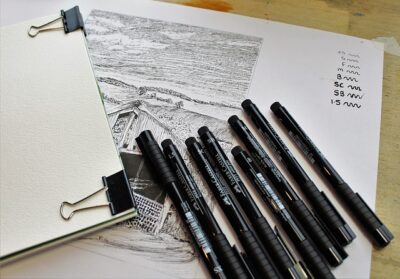
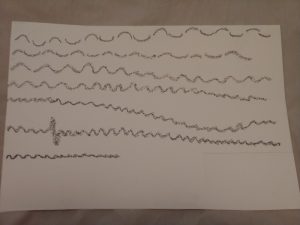 How does your breathing change in a moment of crisis? Does it become fast and shallow? Is it difficult or painful? Do you hold it in as if it is the last bit of air to ever pass through your lungs? First tightening into a knot, my chest shifts to rapid, shallow breaths, leaving little room for oxygen to pass in or out. This exercise is an opportunity to evaluate changes in the patterns of depth and duration of breaths through mindfulness techniques. After experimenting with various strokes and lines/squiggles, a wave pattern felt most natural and comfortable to me, though awkward at first. Closing my eyes made it easier to focus on my breath, getting evermore shallow as the five minutes seemed to go on for ten. Upon opening my eyes, I saw on paper the result of heading towards an anxiety attack and my inhalations increasing in number, but decreasing in duration. While this exercise shows that not every tool works efficiently for every person, the second part of this gave me the key to working on mindfulness through breathing.


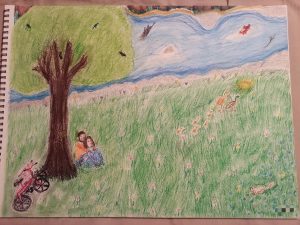 Take a moment and allow your mind to drift off to a specific location or place where you have experienced comfort. Are you by a river or stream? In the forest? In a log cabin far away from any living soul? Are you reading a book or taking a long, hot bath? Is anyone there with you or are you by yourself?


