
Blogs

Spiritual Abuse & Emasculated Men

A topic that often comes up in our support groups is how women are usually hit harder than men in spiritually abusive churches and groups. It often is mentioned in conjunction with ‘holiness standards‘ and submission. The subject arose once more a couple days ago and in reflecting, I was reminded of some things that married men have shared through the years, a topic that can be difficult for them to discuss. There are men who feel emasculated by the teachings of these churches and how the pastor basically takes their place as the husband. It has been asked, “How many women are having an emotional affair with the pastor and church because their husband can’t quite measure up?”

It seems to happen more often when the man isn’t part of the church or once was but left, or he attends but doesn’t fall in line with all the teachings. However, it also strikes men who are fully immersed in the group. As one shared, “The implied message was that it is more important to be dedicated to the church than it is to your husband. …I didn’t know that the pastor was also married to my wife…strange. Or that he was one of the heads mentioned in the scripture.”

This mindset places tremendous strain and pressure on a marriage and works to emasculate the husband, depriving him of his role and causing him to feel replaced, almost unwanted at times, and less than a man. In situations where there are children, sometimes the wife, and even other family members in the church, will say negative things to the children about their father that can cause relationship problems between them. It can bring untold conflicting feelings, angst and even fear that their dad will burn in hell, a terrifying thought for a child. The women appear to be blinded to the damage they cause as they believe they are following the will of God.

A person asked, “What is it that makes the man (or wife) think he ‘can’t measure up’? …How can a woman put the pastor higher than the man that brings home the bacon, pays the bills and cares for the family? How is it the man that never mowed the lawn, never paid one household bill (probably does not even hold a job) is the man that is superior?” This thought of any pastor being superior to others does not fit in with how the body of Christ is described in 1 Corinthians 12.

One man responded, “This is what the man is reduced to bringing home the bacon, paying the bills, and supplying non-emotional or spiritual needs. Anything else is perceived as an effort to try and convince or change the doctrine/beliefs of the wife, which in turn leads to accusations of the husband trying to break up the family. Unfortunately the woman in many cases makes the statement, ‘when I see you praying, and fasting, (until I see you are worthy) then I will submit to your authority or consider you the priest of our home.’ This obviously is not consistent with scripture.”

In these unhealthy churches, the pastor is usually considered superior to others in the church and this plays into the emasculation of the other men. In fact, some pastors flat out tell people to imitate them in prayer, worship, dress, etc. In addition some claim that one cannot be saved without them. “The only way you’re ever going to get to Christ is to follow a man of God. The only way that you’re ever going to make it in the rapture is to follow a man of God. Amen! You can’t make it without a pastor.” (Quote is from the linked to video.)

So how does the man (pastor) appear superior to the husband? “When he is one who holds dedication, loyalty, and commitment overhead with hell fire and damnation, he certainly can [appear superior]. Conversely, because of the impression he gives of having a pipeline directly to the throne, and with statements and perceptions that no one can or should be more spiritual than the pastor, sure, that husband will never and can never measure up.” Imagine how this makes the man feel and what it does to him and how it insidiously works to destroy the marriage. If that man eventually gives up and walks away, it is entirely blamed on him for not measuring up.

Some seemingly fight a losing battle in attempting to regain their rightful place in the family. As long as the spouse places the pastor and church above her husband, there will be problems in the marriage and sometimes it cannot be overcome. Unfortunately, pastors have told wives to divorce. “Apparently, the pastor told my wife that if I don’t come around, and fall in line with all that he teaches, she shouldn’t stay with me. The same man who married us, suggests that, for the sake of her soul, she should probably leave me.” Such counsel goes against the admonition of the Apostle Paul in 1 Corinthians 7.

A woman shared some observations, “I have seen this kind of stuff going on. Women who think their husbands have no merit in the kingdom of God just because they aren’t like other women’s husbands. They usually have no respect for them and undermine their authority in the home. The children are taught that their father does not know anything. They are pretty confused… The wife runs to the pastor or other spiritual men, counseling with them. She constantly compares her husband with other men….why can’t he be like them?

“…I think if we were not taught erroneously to begin with…that the pastor is like the Pope and only he can hear from God for us…then many of us would have better marriages and better relationships with God. I have never spoken with men to get their viewpoint of what they think of their wives running off to the pastor every time they turn around. I think some of them are conditioned to think it’s OK.”

Another woman told of an event. “Last year at summer camp all the women were invited to lunch with the pastor and were also shown his bedroom with the comment ‘see how clean and tidy he is, not like your slobby husbands.’ Well, for those women with slobby husbands I’m pretty sure they did get mind problems the next time their husband left his clothes on the floor, remembering that nice tidy pastor’s room (which had been cleaned beforehand by a few of the women anyway). We were continually reminded of how our husbands didn’t measure up but if you dared to come out with it yourself you were a Jezebel bitch. So it was a no win situation for everybody.”

This is a very serious problem in unhealthy churches. While there are people who sincerely believe they are doing God’s will by placing church and pastor above their spouse, they fail to realize how their actions are ripping their family apart, harming their children and causing excruciatingly deep hurt to their spouse. Is this not spiritual adultery as one man observed? Take to heart what he shared. “This is so true. Not only putting the pastor in the place of God, but putting the pastor or church above the place of your husband. The hierarchy that God designed and that Paul outlined is pretty much cast into the fire by the UPC, there is no church, or pastor between God, the Man, and his Wife. It is so wrong for the pastor to demand a devotion to him, his doctrine, his perspective, and his general way of doing things. Sometimes I don’t think they do this openly or even purposely but they use various controlling techniques to demand devotion in general.

“It is so funny how most every UPC church has a name, but we don’t refer to them that way, instead we say, ‘I used to belong to Bro. Smith’s church, or I visited Bro. Jones’ church, or my sister belongs to Bro. Johnson’s church.’

“I would covet an opportunity to talk to a pastor’s wife to see how she felt about or even realizes that her husband has the devotion and attention of the women in their church above and stronger than the devotion to their husbands. How many people have the courage to call it religious and maybe spiritual adultery?”

Read Religious Cuckoldry by Dr. Michael Warstler, an essay on this same topic.

********
Shop at our Amazon store! As an Amazon Influencer, this website earns from qualifying purchases.

When Extreme Churches Collide

Many of the blogs shared cover some deep, even painful topics. This one will attempt to share a lighter aspect of the abusive church environment – what happens when two such churches compete on the same turf for new converts.

The church I attended (a UPCI breakaway church) had its main headquarters in Waukegan, Illinois. This was a short drive from the Navy base at Great Lakes, and we even had a serviceman’s center on the North Chicago strip outside one of the main gates. This made it very easy for us to travel to the base and attempt to proselytize the sailors; I was stationed at Great Lakes on several occasions and was very active in the base ministry.

We weren’t the only church competing for members on the base. An IFB megachurch (Independent Fundamental Baptist) from Hammond, Indiana sent men from their Bible college to the base every weekend. Their sales pitch included inviting the sailors for a game of football or basketball depending on the season. Most of the students from the IFB church weren’t in the military, but back then it was fairly easy for civilians to access the base as it was before 9/11.

The fun started whenever we met the IFB guys and typically they would try to invite us to the sporting events. From there, the conversation quickly escalated to a debate over doctrine and whether or not any of us were going to heaven. Sometimes the debate got heated when the subject arose about which one of us was “the true church” and which one was a cult. On some occasions it nearly became a shouting match. This wasn’t really a surprise as the pastors of our respective churches were known to bash one another from the pulpit.

What did I learn from the experiences? Both churches drilled Scriptural knowledge deep in our heads, and admonished us to defend our beliefs no matter what. Both churches also encouraged us to be quick to call out who we thought were false teachers. We were also quick to call someone who disagreed with us a cult. The most significant thing I learned was that despite our doctrinal differences, the manner of indoctrination, abuse, and control was practically identical. Our tactics in outreach were basically the same, only my former church was much closer to the base. Our respective leaders were also steeped in controversy; the IFB pastor at that time had numerous allegations of abuse and control, and our general pastor did as well including prison time.

This is why survivor groups like this are important. Our stories cross denominational and doctrinal lines, and we are often more alike than we wish to think.

********
Shop at our Amazon store! As an Amazon Influencer, this website earns from qualifying purchases.

What made Jesus mad?

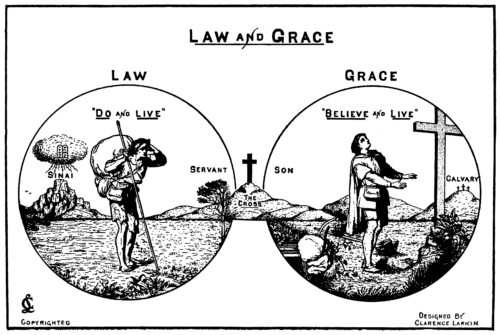
It wasn’t the sinners. No, he ate dinner with them. What we see Jesus fighting against are the religious Pharisees who loved to point fingers at other people’s sin and shortcomings. Legalism. It is essentially the world system telling you that salvation is not a free gift and that you must work for your grace. Grace is a free gift. If it comes with ‘requirements’ is is no longer a gift, but a paycheck. Jesus came to save the world not condemn it. A lot of these issues come from people trying to make the Bible fit their opinions. They refuse to research culture, translations, Hebrew, Greek, etc.. They fall under the influence of the adversary and believe we are not worthy of God’s acceptance unless we perform. God loves you; you have to switch your focus from you and onto what He did (and is) doing for us. By saying a dress, long hair, no jewelry, and no makeup is required to get into Heaven, you have rejected the power of Jesus dying and resurrecting by saying – No God, I think I got this. No thanks, I can save myself. However, it isn’t about us. It is all about HIM and what HE did for us.

It. Is. That. Simple.That is the GOOD NEWS!

Let’s take a look at the scriptures and see what they say.

In Matthew 23:27, Jesus addressed the Pharisees who were being judgmental and holding on to a ‘visual and works-based’ salvation by saying, “Woe to you, scribes and Pharisees, hypocrites! You are like whitewashed tombs, which appear beautiful on the outside, but inside are full of dead men’s bones and every impurity. In the same way, on the outside you seem righteous to people, but inside you are full of hypocrisy and lawlessness.” This statement was radical then and it still is today! What good is it if we visually look ‘set apart’ but we are bitter, prideful, and show no love? That is what Jesus means by a  whitewashed tomb! Jesus also declares the Pharisees hypocrites for straining out a gnat but eating a camel (Matt. 23:24). This was a parable about worrying about small things but yet, you are full of hatred and pride – which are BIG issues. We must cleans our hearts. As we do this, we will reflect Christ on the outside by our actions. We are becoming love. It isn’t a checklist, it is a process; one that can take years as we begin to heal the many layers of shame, guilt, and pain that we have endured. We must have faith. Believing in something we cannot….see.

We tend to think of a Pharisee as just a Jewish person who didn’t accept Jesus as the Messiah. Why did they reject Him? Jesus was viewed as radical. His message was a 360 from the Law of Moses (Read the book of Leviticus). Moses taught you must perform a certain way to be clean. Jesus taught that God already sees us as clean and we will have eternal life if we accept Him into our hearts as our Lord and Savior. There are many more accounts recorded in the New Testament where Jesus denounced the religious hypocrites, but I would like to now focus on the gospel. The good news. We cannot follow something we do not….know. The good news is that God already loves us and he loves us with agape love. Agape love is unconditional love. Meaning, there are no conditions in which we can make God love us more or less. He loves us because He is love. Scripture tells us this.

1 John 4:8 “The one who does not love does not know God, because God is love.”

Romans 8:39 tells us that nothing can separate us from love. Nothing. Not your skirt that is above your knees, your short hair, your bitterness, your lies….NOTHING. It is written, “(No) height or depth, or any other created thing will have the power to separate us from the love of God that is in Christ Jesus our Lord!” Praise God for that because it is impossible to be sinless, but fear not! We are loved by God and we have been bought and paid for.

John 17:23 “I am in them and You are in Me. May they be made completely one, so the world may know You have sent Me and have loved them as You have loved Me.” This right here tells us we are loved the same way Jesus is loved. Hallelujah!

Ephesians 1:7-8 “We have redemption in Him through His blood, the forgiveness of our trespasses, according to the riches of His grace that He lavished on us with all wisdom and understanding.” He has redeemed us! We are set free.

1 Corinthians 12:13 “For we were all baptized by one Spirit into one body—whether Jews or Greeks, whether slaves or free—and we were all made to drink of one Spirit.” God does not see a sinner when He looks at us. We have been baptized into Christ.

While we have this good news, so many people reject it. It is difficult for the human mind to grasp this concept that we are loved unconditionally by God. Another argument I have heard time and time again is that the God of the Old Testament was mean and full of wrath. Yes, people were killed, but the Bible is not a book of condemnation, it is a book about God’s redemption plan to save mankind after the fall. The only reason people were wiped away was due to their motives to wipe out the line to Jesus Christ. God had to preserve that at all costs because Jesus is the ONLY way to eternal life without pain and suffering.

If God was mad at us, why did he make a promise to Abraham that he would use his seed to bless the world? God made this promise in the very first book of the Bible. He wouldn’t do this if He regretted creating us. He promised Abraham, Issac, and Jacob (Israel) that He would redeem us through their bloodline. We now know that redemption plan was finished with Jesus Christ. The adversary tricked Adam and Eve to eat from the Tree of Good and Evil by making them feel God was hiding something from them. After the fall, they felt shame and guilt. Something God never wanted for us. The reason we felt naked was because of the enemy. Not God. We clothe ourselves to hide shame. If it was Satan who told us we were unclean in the garden, is it not Satan who is inside your head telling you that you are unclean if you don’t perform or wear certain types of attire?

One last thought. Fear in Hebrew does not translate to being scared. To fear God in the original text means to have childlike wonder and awe of God. Fear = awe. How easily we can get tricked into thinking God is angry with us. Satan has done this since the fall. The devil is the father of all lies and he knows no new tricks.

The good news is that the battle has been won. Jesus conquered the grave. We have redemption through Jesus Christ and we are covered by the blood of the lamb. Stop listening to the lies of the enemy. Read the word for yourself, rather than believing everything another human tells you. You can even question me and what I have written here in this article. Actually, I encourage you to. Seek to find the truth! The Holy Spirit will slowly reveal it if you ask for it.

We are no longer slaves. Thank you Jesus for this unconditional, undeserved gift of grace and eternal life.

Let your Kingdom come. Your will be done on earth as is it in Heaven. Until you return, I will praise You and spread this wonderful, life-giving news of how You died for me, and…..the world.  I pray that every person who reads this will be filled with a seed of Truth. In Jesus’ name I declare this. Amen.

–GodIsLove

********
Shop at our Amazon store! As an Amazon Influencer, this website earns from qualifying purchases.

Victim Blaming

Over the weekend, the Catholic Church was rocked with more upsetting news concerning the scandals involving priests molesting children. Pope Francis delivered a homily where he blamed Satan for exposing sin in the church. I rolled my eyes in disbelief as I read the pontiff’s comments.

Looking back on my own experiences and corresponding with others who went through similar ordeals, it doesn’t shock me as much as it might have a decade ago. Too often, church leaders place the blame everywhere BUT on the abuser. When a victim or concerned member voices concern or attempts to report abuse, they are quickly silenced.

How many times have we heard pastors say “touch not God’s anointed” when allegations of abuse surface? How many times are church members excoriated for “spreading gossip” or “negative communication?” I personally was admonished to simply shut up and “focus on the good, pure, and lovely things” on numerous occasions. This attitude of turning a blind eye only worsens the problem.

In another abuse survivors group, an account was shared of how a teenage girl and her family left a large church in Indiana after the senior pastor was caught taking the girl out of state for sex. This pastor even went so far as to blame the girl for leading him into sin, after he groomed and had his way with her for some time. The pastor was rightly sent to prison.

When I was a teenager in the late 1970’s, I read in history class about the great revivals that occurred in the early 20th century. Why don’t we see that now? I believe part of it is here. Until the church takes abuse victims seriously, and purges perverts from the ranks, folks will stay away from houses of worship.

Those who preach the gospel must live the gospel.

********
Shop at our Amazon store! As an Amazon Influencer, this website earns from qualifying purchases.

The Pharisees and Apostolics Part 3

This is a continuation from Part 2. Thoughts are based off the article, Are Apostolics Pharisees? written by Gary R. Trzcinski, which appeared in the September 1996 Pentecostal Herald (now called Pentecostal Life, the official magazine of the United Pentecostal Church) which addressed the issue of whether Apostolics (Oneness Pentecostals) were Pharisees. The author gave 29 points as to why they were not.

Below is an excerpt:

Pharisees never criticized Jesus or His disciples for their physical appearance (hair, modesty, ornamentation). We do not find one verse of Scripture where they ever condemned Jesus and His followers for the way they looked. Many Pharisees were waiting to find one flaw in Jesus so that they could discredit Him and His teachings. If there would have been something wrong, the Pharisees would have found it. But they found nothing. Why? Because there was nothing to find, nothing to criticize.

The Pharisees were somewhat holy looking on the outside but extremely unholy in their hearts. However, Jesus was holy both inside and out. He was the perfect man. “Let us cleanse ourselves from all filthiness of the flesh and spirit, perfecting holiness in the fear of God” (2 Corinthians 7:1).

Why is it that the Pharisees didn’t criticize their appearance? This argument actually works against what the author has stated about being different from ‘the world.’ If Jesus and the disciples looked distinctly different from ‘the world,’ as the UPC teaches we in North America must do today, then would they not have pointed this out? It is somewhat misleading to state they were looking for one flaw as they pointed out several in Jesus and his disciples. They took note that Jesus ate and spent time with sinners, they reprimanded them for eating with unwashed hands and said Jesus was gluttonous and a winebibber…so would they not have made note of any appearance which stood out from those around them? Could it be that Jesus and his followers appeared like ‘the world’? Or are we to believe there was a difference in the definition of ‘the world’ some 2000 years ago?

By mentioning “hair, modesty, ornamentation” the author appears to want readers to link this to standards taught in the UPCI, as if they were being followed by Jesus and his disciples. Yet not once do we read that Jesus taught against jewelry, make-up, cutting hair and so forth. He was silent on such issues that the UPCI feels are extremely important. Similarly, Jesus did not teach or follow the rules which the Pharisees added to the law.

The Pharisees were somewhat holy looking on the outside but extremely unholy in their hearts.” Actually, they weren’t just somewhat…Jesus said that they made clean the outside of the cup and platter. Anyone can make themselves look good to others in this manner.  Consider that the heart of the Pharisee wasn’t really toward God and Jesus pronounced them dead on the inside, yet they were able to present to others the image of a sparkling clean and holy exterior, one they thought would cause people to be envious and look up to them.

Pharisees only cleansed the outward appearance but neglected the sinful human heart. They were righteous on the outside but evil on the inside. They were hypocrites (Matthew 23:25-28); but we abhor hypocrisy. Apostolics seek to clean not only the outward appearance but also the heart, mind, and human spirit. Jesus asserted: “Cleanse first that which is within the cup and platter, that the outside of them may be clean also” (Matthew 23:26). A cleansing of the inside will eventually lead to a cleansing of the outside.

The vast majority of our preaching and efforts center on the redemption of the soul. And yet we would be hypocrites if we willfully neglected those passages of Scripture pertaining to cleansing the outward appearance (1 Corinthians 11:4-16; 1 Timothy 2:9-10; 1 Peter 3:3-4). We follow the admonition of Paul to abstain from all appearance of evil so that we would be sanctified wholly- spirit, soul, and body (1 Thessalonians 5:22-23).

If the inside is clean, then it cannot help but show outwardly–and not simply in our appearance, but more importantly in our actions. This is the work of the Holy Spirit in the believer’s life. This is part of the problem in performance oriented churches- they cause people to believe that they must work to make themselves holy and acceptable to God. Don’t cut your hair or wear jewelry and make-up, be sure dresses and skirts fall below the knees, watch your sleeve length and maybe you will be pleasing to God and accepted. Yet the book of Galatians makes it extremely clear that our righteousness will never come from our own works, but it is by faith in Jesus that we are made righteous in the sight of God. If the law was only to act as a guardian until Jesus came, why would we now need any other set of laws to ‘protect’ us or act as a fence to keep us safe? Think about it. Written laws do not change the person. The Old Testament law did not make the people righteous by obeying it as they were not changed on the inside. No list of rules is going to change us either, no matter how good the intentions.

The author claims that Apostolics “abhor hypocrisy” and yet most of us who have been part of them have seen it in multiple ways. There were the ministers that taught against television and owned one themselves or would otherwise have ways to watch it. They teach women’s hair is to be uncut yet some women hide their trimmed hair by wearing it up. They teach against jewelry but wear similar ornamentation in their hair or on their shoes. In some of their churches men are taught they must be clean shaven but the rule can be temporarily bypassed for those who participate in a Christmas or Easter play. How many times have you heard a minister proclaim how people can shout at a sporting event (some are against attending these) and then compare that to how one is to act in a church service? What about the sermons which state smoking is defiling the temple of the Holy Spirit and yet they ignore where the Bible actually speaks against gluttony? These are just a few of the ways in which hypocrisy has been seen in their midst.

I will close with the thoughts of a friend:

You know, as I think about this, it’s not so much the grace thing, as is the need to have something that can be seen. It’s easier to trust in that which can be seen, it is easier to maintain control over what can be seen. When one is seen doing all that is required, then the pastor can rest assured that he has control over that person. When the standards are broken, then the pastor knows for sure that that person needs reprimanding, and many are quite willing to join in on the flogging! I’ve seen this first hand in my former church, especially with the young people.

It’s harder to let go of the reins and let the spirit have his way. Those in control feel that they must be enforcing something or some kind of rule, etc. I think it comes down to more of a trust issue for many in UPC, afraid to trust in that which can’t be seen, unless there is evidence through obedience.

The Pharisees and Apostolics Part 1

********
Shop at our Amazon store! As an Amazon Influencer, this website earns from qualifying purchases.

Click to access the login or register cheese
YouTube
YouTube
Set Youtube Channel ID
BLUESKY
Protected By
Shield Security PRO