Blogs

Shattering Ice

At the last minute, I grabbed some towels and stuck them in the van for after. I knew the recent snows would make the trails cakey muddy. I wanted to be OK with that, let the kids play, not be cautioning them and admonishing them because of the potential mess. This was our kids’ first full American winter after a childhood spent overseas. I wanted everyone to be free to enjoy the blue sky and the red rocks and the slightly warmed air. I guess I wanted the mud and mess to not matter.

We hiked a bit, then arrived at the iced-over pond just over a hill. My kids picked at the edges of the ice with toes and hands, breaking bits off. They raised chunks above their heads, then dropped them onto the ground. The ice shattered into sharped-edged shapes.

“We’re breaking windows,” one of them joked.

“This is strangely satisfying,” another said.

They named it “Ice Pile,” as proud as if they’d spent years designing the haphazard structure.

To me, it looked like a dozen broken puzzles all mixed together. I waffled, unsteady, between agreeing with their satisfaction at the sound of breakage to wishing I could piece it all back into a picturesque whole.

They soon moved onto throwing rocks on the pond, determined to break through the ice. We’d had many 60-degree winter days sandwiched in between frigid snowy days. So, the ice, as far as we could tell from the chunks, was only an inch thick, with a few long cracks over the surface. We all felt sure that if they found a big enough rock or threw one hard enough, it could easily make a hole. Maybe it could even cause a ripple of cracks throughout the whole pond.

But big boulders, or small rocks thrown with great might—they all skidded over the surface, the sound of contact a boingy repetition that made us all laugh. The only breakage they could manage was at the very edge, which they worked on diligently. I knew the next day’s promised snow storm would ice it all over again.

The Storm

I was trying to play, and relax and enjoy. But I couldn’t help but think about the attempts I’d recently tried to break through an unhealthy system. When I reported to leaders the spiritual abuse I’d experienced within the organization of which I was a part, I felt like I was in the middle of a storm on the ocean. The choppy waters slapped against me, the shore too far to reach. In order to keep from drowning, I felt like I had to build my own raft, but first find my own materials, and come up with tools to do it. It seemed like others in my organization were on a gorgeous sailboat in the distance, stretched out on chaise lounge chairs with umbrella drinks in their hands, wondering why I was struggling so much. “Everything’s fine!”

I found some materials and tools I thought would work—organizational policies that seemed to offer protection, the personnel department tasked with following employee laws, a couple of leaders I thought I could trust, my own carefully-thought-out words, all the kindness and patience I could muster, earnest pleas for help, my promised silence if they’d just fix things, and my own attempts to move on in spite of a lack of change and my own wounded faith.

Exiled

In the end, I was thrown onto shore by the organization. It was, I believe, retaliation. Not rescue. It meant we had to move back to our home country, ultimately make a job change, and resulted in the loss of a ministry and wonderful co-workers. Other losses too, some still too painful to list.

“Insubordination” was one of the reasons they used. They used tools, too to build their narrative—harsh, jagged, weaponized distortions of things I used to think could make healthy community. Unity. Reconciliation. Forgiveness. They claimed my husband and I were against all these.

They yanked out of my hands other tools like: my voice, accountability for leaders, best practices, protection of subordinates.

I landed hard on the shore, sand in my eyes, the few belongings I’d managed to grab dirty and scattered. I felt exiled, shamed, unwanted, misunderstood. At first, I’d walk to the edge of the water, longing to be invited onto their sailboat, begging to explain myself better. I kept my back turned to the beach, my eyes ignoring the storms that continued to brew at sea. Eventually, though, I looked around, noticed the soft sand, the light breezes, the green trees, the people there to greet me.

I’d made it out of the storm, just not in the way I’d wanted.

Sorting Out the Pieces

The months passed, and I tried to sort it all out, but the metaphors got mixed for me. Was I trying to get to shore? Or was I trying to knock through the ice, crack open what seemed wrong? Or am I try to piece something that was shattered back together again? Or am I what was shattered? And what do I do with the other things in the water—the good that I believe the organization is doing, the lifeboats they’re tossing to needy people, the lighthouse of faith they point to?

And what of the future? Do they own the entirety of oceans or are they just a small pond in this big world? Can I get back in the water somewhere else and not be consumed with its waves?

My husband has been in this whole thing with me. As a result, he’s now starting a new job, going through training, trying to focus on his studies, but also thinking about our new mortgage, and our kids’ needs, and the many costs of sudden transition. His roommate in training is just out of college, much younger, confident, optimistic. He believes in himself and the system in a way that seems lost to my husband and me at this point.

My husband called me from the place where he’s training, after I’d returned from the pond. “I’m not like that anymore,” he said, telling me how his roommate went out for dinner while my husband stayed in the room to study. “I know now that bad stuff can and does happen.”

“I’m with you,” I said. Then trying to be brave, “Don’t worry. I’m ready for whatever does happen. We’ll figure it out. It’ll be an adventure.”

Who Am I Now?

I’ve been talking with a friend of mine about platitudes, how we both hate them for their lack of complexity, reality, nuance and understanding of suffering in this world. But as I said them to my husband, I felt less like I’m offering him hollow sayings and more like I’m sorting through the pieces of who I was, or who I am, or maybe who I want to be, to see if they still fit. Have I just returned from a grand adventure, or a doomed endeavor? Am I brave or broken? Am I a warrior for speaking up or a traitor for speaking ill? Am I free to move forward, or stuck in exile? Will life be better or harder than it was in the ocean?

I told my husband about the pond, the rocks that skidded over the ice, the boingy sound, and that I’d remembered to bring towels for muddy shoes and hands. I sent him a picture I’d snapped with my phone. The scene looked like it could’ve been made into a boxed puzzle with its blue sky, icy pond, mountains and bright sun. I noticed for the first time the logs caught half submerged, stuck at strange angles. Though ice can look picturesque, it has a way of trapping things that should be free.

I recently saw a You Tube video about how it’s possible to skate on thin ice, if done just right. The video of the man skating showed the boingy sound as he glided. The reason, the video said, that even thin ice is still strong is because of two things: the power of the water underneath holding it up, and the attachment of the ice to the sides of the shore.

I thought how I was no longer part of water holding up ice. I thought, too, of how my kids and I chipped away at the edges and how it felt futile. But maybe, just maybe, it was making a difference.

I don’t know what will happen to that organization, don’t know if the ice there will someday be broken, or will melt, or will just keep refreezing in perpetual winter.

I do know, though, that spring follows winter. On this shore, anyway. And when it does, I’ve already decided. I’ll dip my toes in the water, testing to see if it’s safe to swim here. And then, towel nearby, I’ll take it a step at a time.

********
Shop at our Amazon store! As an Amazon Influencer, this website earns from qualifying purchases.


Please stop talking about Jezebel…

Ok – so first off, I’m not saying to stop talking about the Bible, or the story of Jezebel! There is a powerful principle of being unequally yoked together with an unbeliever. In the case of Ahab, a Jewish King, marrying a Canaanite princess, who served many gods was a disgrace to the line of Israel and a continuation, as 1 Kings 16 declares, the sins of many kings before Ahab.

What I actually want to stop talking about, I’m going to talk about it…and that is the effort to use Jezebel as the foundation for the house of cards within the Holiness movement as the anti-make-up and jewelry monument (idol). A statue erected and constantly glorified across pulpits to disparage and to dissuade the usage of such things. You’ll hear all about the Jezebel spirit, the ‘harlot’ spirit. I’ve heard so-called Christian women refer to another woman who wears make-up in such a fashion, “Just look at that Jezebel!”

In fact, the inspiration to this writing is a comment I received on my article Why do some legalists forbid wearing Jewelry and Makeup?  that again used the ‘Jezebel’ reference. And I don’t mean to disparage the person making that honest comment, but something glaring came from it that can and should be addressed.

Description vs. Prescription

I can’t help but remember a Baptist preacher who taught on the transitional nature of the Book of Acts and how certain people ‘hang their necks’ on certain portions of Scripture without seeing the fullness of the entire testimony. In that particular case, he was speaking of the way in which the Oneness Pentecostal doctrine views Acts 2:38 as the fullness of Gospel salvation (how to get saved) but do not read the rest of the book as the description of history and transition as it was played out.

This was something that my studies also led me to understand. The book of Acts was a description of the forming of the New Testament church, it is a window into the history of the Apostles, early missionary journeys, and incredibly, the way in which the Gospel was opened up to the Gentile bride (Acts 7/8) due to the thrice rejection of the Messiah by the Jewish people.

As we see the transitions take place we also notice some fundamental changes (requirements) because of a shift from a Jewish to a Gentile audience. And there is a difference. (Acts 15, Jewish Believers still maintained the Law of Moses, Gentile Believers did not and are not commanded to) But the description of early church practices, such as communal living, selling all earthly goods was certainly NOT a prescription (commandment) to the entire New Testament church from the days of the Apostles up to the second coming of Christ.

For example, let us look at some very plain prescriptions (commandments) vs. descriptions to illustrate the difference and why it matters in this narrative.

Prescriptive Text:

“Or do you not know that the unrighteous will not inherit the kingdom of God? Do not be deceived: neither the sexually immoral, nor idolaters, nor adulterers, nor men who practice homosexuality, nor thieves, nor the greedy, nor drunkards, nor revilers, nor swindlers will inherit the kingdom of God.” ~ 1 Corinthians 6:9-10, ESV

From this text, we draw very clear and strong conclusions of a commandment. Much like the original commandments that Yahweh gave to Moses, they weren’t ambiguous, unclear, nor arguable or debatable. The pronouncement is clear: People who do certain behaviors will not inherit (enter into) the kingdom of God.

Descriptive Text:

“And awe came upon every soul, and many wonders and signs were being done through the apostles. And all who believed were together and had all things in common. And they were selling their possessions and belongings and distributing the proceeds to all, as any had need.” ~ Acts 2:43-45, ESV

From this text, we draw a conclusion that the early church was very communal, taking care of the physical (food, clothing, shelter) needs of each other as was needed under the persecution taking place, not just from the Roman front, but later a Jewish attack against Christianity.

The times demanded particular behaviors, and while we read about them, we don’t take this description/history as a prescription (commandment) that we are to sell all of our belongings, develop communes and live as a single community.

In a negative light or a positive light, descriptive texts should not be used as foundations or proof texts for prescriptive commandments unless they are coupled with very clear commandments.

Jezebel, the Golden Calf of the Holiness Movement

Recently, a comment was left on a previous article as I already mentioned. This is not a criticism of the commenter, just an illustration of how this connection happens;

We cannot take just 1 Bible Verse and ‘run away with it.’ We must read the ENTIRE meaning.
They decked their Faces with Paint (Make-up), and put on Ornament (Jewelry) also. Does that not sound like Jezebel to you?

This is in reference to Ezekiel 23, an incredibly strong, blatant, graphic account of the harlotry of Jerusalem and Samaria, symbolized as two sisters who engaged in much prostitution, debauchery, and idolatry who had turned away from the Lord. This prophecy, given to Ezekiel, was intended to provoke the prophet into proclaiming God’s disgust, displeasure, and desire for repentance upon the lands that he called his own. Verse 36 even says, “Son of man (Ezekiel), will you judge Oholah and Ohobilah? Then confront them with their detestable practices.”

The two sisters, Oholah (Samaria, the Gentiles) and Oholibah, (Jerusalem, the Jews) at one point were prophetically (not literally) decked with crowns, bracelets, make-up, oils and fine linens, beds, etc., and then judgment came upon them for their prostitution, adultery, and debauchery. Nowhere in this description, nor elsewhere, does Scripture teach that make-up, and/or jewelry was the prescription for their debauchery, and yet we can see and hear people making this connection via the Jezebel story simply because of the mention in Scripture.

We could conclude, as others have with the make-up and jewelry, that the olive oil, beds, fine linen, and other descriptive items were equally sinful, right? There is no doubt a reason for the mentioning of these things, but to use ‘honorable mentions’ as commandment prescription is dangerous, to the creation of false doctrines.

Jezebel

1 Kings 16-22 recounts the history of King Ahab of Jerusalem who reigned C 874-853 BC and includes the final days of Elijah the prophet who was responsible for the killing of the prophets of Baal (the religion to which Jezebel belonged) (1 Kings 18) and then his fleeing from the wrath of Jezebel in 1 Kings 19.

The problem with Jezebel and Ahab was not the make-up, nor jewelry. Rather, it was that Ahab was far from God, Yahweh, and marrying a princess of Caanan brought with it the need to erect temples to the false god Baal (1 Kings 16:32) in order to please Jezebel.

The story of Jezebel picks back up in 2 Kings chapter 9, long after Ahab’s death. When Elisha anoints Jehu (2 Kings 9:6) as King his first commandment, and seemingly the reason for Jehu’s anointing, is to destroy the house of Ahab and with it, the judgment of Jezebel for the murder of God’s prophets and people that she had wrought in retaliation for the slaying of the priests of Baal by the hands of Elijah. (1 Kings 18:20-22)

And the only portion of this story that comes up in this particular vein of thought is one small verse, that says, “And she painted her eyes and adorned her head and looked out of the window.” (2 Kings 9:30)

Somehow this simple act of hers, obviously attempting to disarm Jehu with her beauty, is the crux of the story. Little mention is given of her life of sin, murder, worship of false gods, the destruction she brought to the priests of Yahweh. Rather, all the legalists can focus on, is that she painted her eyes and put on a wig. Thus, anyone who paints her eyes and wears a wig…is a Jezebel.

Conclusion

At this point, it seems almost a moot point to iterate again how silly of an argument this is, but there are people who believe it so it is important, in love to explain these things. This article is long for a reason – because we needed the contrast of descriptive vs. prescriptive texts to understand the literary meanings being expressed by the writers, then twisted and perverted by modern readers.

As noted in my original article, Why do some legalists forbid wearing Jewelry and Makeup, there are many locations within Scripture that speak very, very favorably of make-up, and jewelry, the adorning of the body, and indeed even makes the connection with the Bride of Christ (the Church) preparing herself for her groom (Christ). (Rev 21:2)

10-Coin Jewish Head Dress

There are many great resources into the customs of Jewish weddings, the attire of men and women in that ceremony. The 10-coined headdress, necklaces, and other jewelry were part of a traditional, sacred Jewish wedding ceremony. MacArthur and other Bible commentators have made notes about this when reviewing select Scriptures. We even see the God of Heaven and Earth, in the form of man, Jesus Christ, speaking of these coins in the parable of the lost coin in Luke 15:8-10. And in no way did He (Jesus) condemn this, but rather made the analogous connection of the joy a young woman would feel upon finding one of these lost coins as to the joy expressed in heaven when one sinner repents.

We must be very careful not to add anything, or take anything away, from Scripture, in our attempts to honor Scripture. The legalist will add to the word their own concocted dogmas, such as we are speaking about here, while the equal and opposite force will attempt to take things out of Scripture for the sake of not offending people or for allowing sinful behavior. Both are condemned in Scripture. (Deut 4:2, Deut 12:32, Rev 22:18)

Just for the record – I’m not out here arguing these points to get people to do these things. My wife does not wear make-up, and I’ve never asked her to. She doesn’t need to, and only will if she chooses to, and that makes me happy. My purpose is not to endorse the make-up industry but to endorse the proper handling of the Bible.

********
Shop at our Amazon store! As an Amazon Influencer, this website earns from qualifying purchases.

Resolution: Courage To Be Myself

Oh how I dislike those pesky resolutions that we all make, hoping that we can at least complete one from our lists. So…how many have you completed? If you are like me it’s probably none…zilch…nada…zero!

Of course this could be the year that I will complete at least one of my resolutions. So why is this year any different? Is it me? Are my resolutions easier? Are they as challenging as prior years? Maybe not, but this year I want to have the Courage To Be Myself.

I want to have the courage to embrace my strengths, get excited about life, and enjoy giving and receiving love.

I want to face and transform my fears. Ask for help and support when I need it. Spring free of the Superwoman trap. I need to trust myself to make my own decisions and choices. Befriend myself and complete unfinished business and realize that I have emotional and practical rights.

I want to talk as nicely to myself as I do my plants and flowers in my garden. Communicate lovingly while understanding my goals. Honor my own needs and give myself credit for my accomplishments.

I need to love that little United Pentecostal Church girl within me and overcome my addiction to approval. Grant myself permission to play and quit being a responsible sponge. I need to feel all of my feelings and act on them appropriately.

I want to nurture others because I want to, not because I have to. I need to choose what is right for me. I need to insist on being paid fairly for what I do. Limits and boundaries need to be set and I need to abide by them. Say “yes”only when I mean it.

I need to have realistic expectations, take some risks and accept change so I can grow through challenges. I want to be totally honest with myself and correct erroneous beliefs and assumptions. Respect my vulnerabilities and heal my old and current wounds.

I want to savor the mystery of the Spirit, wave good-bye to guilt and plant flowers instead of weed thoughts in my mind. Treat myself respect and teach others to do the same. I want to fill my cup first and then nourish others from the overflow.

It is time for me to own my own excellence, plan for my future but live in the present. I need to value my intuition and wisdom and know that I am lovable. It’s okay to celebrate the differences between man and women and develop deeply healthy, supportive relationships. It is very important to make forgiveness a priority!

I need to accept myself just as I am now and learn to take it one step at a time, one day at a time because change takes time.

********
Shop at our Amazon store! As an Amazon Influencer, this website earns from qualifying purchases.

United Pentecostal Pastor Ronald Terry Litz: Child Sexual Assault

This is Part 32 of an ongoing series on sexual abuse in the United Pentecostal Church. Ronald Terry Litz, now 82 years old and living in Glenn Heights, Texas, was born August 11, 1937 and at the time of his sex crimes he was married with three older children, and was the pastor of the Danville Apostolic Church, which was actually in Riverside near Danville. He was living at 702 Fifth Street in Riverside, Pennsylvania and had been the pastor for ten years. The sexual charges against him involved three different teenage boys. The church later became known as Landmark Apostolic Church and Kevin Schramm had been the pastor since May 2008. The name changed once again in the 2020s to Victory Life Church where Aaron Wright is currently the pastor in 2024.

Ronald Terry Litz
Ronald Terry Litz

Ronald Terry Litz, who has gone by his middle name for decades, was the vice-president of the 1963 24 member graduating class of ABI (Apostolic Bible Institute in Minnesota, a UPCI endorsed Bible college). That year, he and his wife, Martha May Litz, were the new Hobby Club Directors working under Mrs. S.G. Norris. (S.G. Norris was the college President.)

It is unknown to me when Litz obtained his United Pentecostal Church license as my older UPCI Directory collection is limited. He is not seen in the editions I have from the 50s and I have none from the 60s. As he was one of their Bible college graduates, one could guess that he may have received license in the 1960s. The 1972-73 Directory has him with a general license in Ohio and the 1975-76 Directory lists him as an ordained minister. There he was the pastor of the Lake Breeze Apostolic Church of Lorain (screen shot of a 1975 ad), a non-affiliated church. (Any church whose pastor is licensed by the UPCI is considered a UPCI church. They can go a step further and have a legal affiliation with the organization. This church did not.) I did find a 1971 ad from an Ohio church in the same town. I have a few directories from the 1980s, starting with 1981 where he is listed as living in Riverside, Pennsylvania and was the pastor of the Danville Apostolic Church, a non-affiliated church in Northumberland County.

I did find a mention of him and the church in a 1978 newspaper article, making him the pastor since at least that year. He is last seen in the 1987 Directory, where his wife was listed as the Ladies Auxiliary Secretary for the Pennsylvania District. In the late 1980s while Litz was pastor, Bill Woodruff, a 1986 ABI graduate, became the Youth Pastor, a Sunday School teacher and a church bus driver at the Danville Apostolic Church, though he did not hold license. After Litz was arrested, Harold I. Lloyd, a United Pentecostal minister with just a local license, became the acting pastor. He is no longer listed as a UPCI minister. No pastor is listed for the church in the 1988 UPCI Directory but in 1989, the church became affiliated while Seth Avery became the new pastor. He is now in Oklahoma.

Ronald Terry Litz
Ronald Terry Litz

The Pennsylvania newspapers started covering Terry Litz’s cases in September of 1987. He was 50 years old when arrested on September 3 and was out on $50,000 bail by the next day. He was arraigned on Friday, October 23, 1987 in Luzerne County, where he entered a not guilty plea and requested a jury trial. His crimes against two boys occurred at the United Pentecostal Church’s Pennsylvania District church camp in Fairmount Township between December 1986 and September 1987. This was in Red Rock in Luzerne County along Route 118. Terry Litz had taken the boys to the camp to help with maintenance chores, where he fondled them and engaged in oral and anal sex.

The two boys were members of the Danville Apostolic Church. Reports varied as to their ages, with one stating both were 15, another said they were 14 and one claimed they were 14 and 15. The charges, filed by the State Police, were involuntary deviate sexual intercourse, indecent assault and corruption of minors. Litz voluntarily resigned as a United Pentecostal minister soon after charges were filed. L. Daniel Garlitz was the Pennsylvania District Superintendent at this time and confirmed that Terry Litz had resigned as pastor and turned in his ministerial credentials. Litz’s wife and 18 year old daughter soon moved to Texas to live with Terry and Martha’s two other daughters.

On March 8, 1988, Terry Litz plead guilty to three counts of involuntary deviate sexual intercourse and five counts each of indecent assault and corruption of minors. He did this as part of a plea agreement that had been discussed with the families of both boys, where the District Attorney was to recommend that he only serve the sentence on one count of involuntary deviate sexual intercourse. The other charges were to run concurrently with this. Whatever time he was to serve in this case, was to run concurrently with a case from Northumberland County. If the judge were to decline the District Attorney’s recommendations, Litz was free to withdraw his guilty pleas.

A sentencing date of May 25, 1988 was set. Michael Dennehy was his attorney, Ann Lokuta was the assistant district attorney and Gifford S. Cappellini, now deceased, was the judge. (See the March 9, 1988 article in PDF format.) In 1992 Lokuta became a judge and was removed from office in 2008 after charges were made against her in 2006 by the Judicial Conduct Board.

Your conduct will require confinement for further protection of young children in our community. Your actions have caused grave emotional consequences for the victims. You were an authority figure and took advantage of young children. – Judge Gifford S. Cappellini in sentencing Ronald Terry Litz

There was a separate criminal case in Northumberland County, where in another plea arrangement Terry Litz plead guilty on February 4, 1988 to three counts of corrupting the morals of minors. Sentencing was scheduled for May but was later postponed until June. The original charges, filed by Riverside Patrolman Steve Watkins, involved three counts of the corruption of morals of a minor and three counts of indecent assault for the oldest victim and one count of each of the same charges for the youngest victim. This involved one of the 15 year old boys from the Luzerne County case, as well as a 14 year old. Litz assaulted the boys in the church office and in Litz’s home. The 15 year old boy’s assault happened on two different days in August 1986. The other was for a July 1987 assault on the 14 year old. The police investigation of these cases caused them to discover the Luzerne County cases.

On March 24, 1988 Jerome Cohen, of the District Attorney’s office, requested a mandatory five year prison sentence, which Litz’s attorney claimed went against the plea agreement where he was orally promised that they would not recommend the mandatory prison time. Dennehy filed a motion to have the judge order them to withdraw it. The District Attorney’s office agreed to withdraw the demand.

Ronald Terry Litz
Ronald Terry Litz 11/10/04

On May 25, 1988, Ronald Terry Litz was sentenced in Luzerne County to two years minus one day to five years minus two days, with five years of probation to follow. He reported to the jail on May 31. The judge told him, “Your conduct will require confinement for further protection of young children in our community. Your actions have caused grave emotional consequences for the victims. You were an authority figure and took advantage of young children. I’ve considered the impact of public shame and humiliation not only to you but to your wife and family. (But) a lessor sentence would depreciate the seriousness of your crimes.” His time was to be served in the Luzerne County Jail instead of state prison, which is why the five year sentence was made to be minus two days. He also received a concurrent sentence of 11 to 23 months on the five counts of indecent assault. He had faced up to twenty years on each of the felony charges of involuntary deviate sexual intercourse, as well as a $25,000 fine.

Litz shared that after serving his sentence, he planned to leave Pennsylvania and volunteered to do community service by speaking to high school groups and civic organizations about sexual abuse. For six weeks prior to sentencing (one report stated three months), Litz underwent weekly psychiatric counseling in a Louisiana hospital, where he claimed he “was able to understand [his] problem.” He continued to attend church. Terry Litz’s attorney admitted that Litz had a problem for years and was molested by an older man when he was twelve years old. Litz expressed remorse for his actions to the victims, his “family, community and profession.” Litz shared that his wife left him, but at some point they got back together after he was released from prison. They own a home and have been together in Texas for many years. He first registered as a sex offender in Glenn Heights on October 31, 1999.

I have tried my best to correct my mistake. All I’m asking is that you have mercy on me. – Ronald Terry Litz, convicted pedophile

On June 28, 1988, for the Northumberland County charges, Judge Samuel Ranck sentenced Ronald Terry Litz to six to 23 months on the three counts of corrupting the morals of minors. It was to run consecutive to the Luzerne County sentence, followed by three years of probation. This was to be served in the Northumberland County Jail after his other sentence was completed. Judge Rank felt Litz received a break in the other cases considering the nature of the charges.

Litz claimed he had visited two psychiatrists prior to his arrest as he had been feeling “urges inside.” He said, “I have tried my best to correct my mistake. All I’m asking is that you have mercy on me.” (Where was his mercy toward the boys while repeatedly assaulting them?) Litz’s attorney submitted a letter showing that he had attended more meetings than required by normal therapy. Also submitted were letters in support of Litz, including a therapist who had placed him on Lithium and a pastor in Belle Chasse, Louisiana, where he lived for awhile after his arrest. At that time, there was one United Pentecostal Church in Belle Chasse, an affiliated one where James Comeaux was, and still is, listed as the pastor. (See the June 29, 1988 article, page one and page two, in PDF format.)

It is draining to compose these articles and my heart grieves for the survivors and their families, as well as the family members of these predators who are innocent of wrongdoing. When I read that a predator considered multiple sexual assaults involving three boys as a “mistake,” I could not help but think that this person is not truly remorseful and has not accepted responsibility for their actions. He reminds me of the alleged pedophile, Steven J. Dahl, who wrote on December 9, 2013, “I made a lot of mistakes, that cost me my future as far as being a minister for the organization.” Assaulting anyone isn’t a “mistake,” but a reprehensible criminal act – a devastatingly life-altering violation of an individual. His attorney said that Terry Litz had a problem for years. One can only ask, and wonder, how many victims were there before these three? Are there any from when he was a pastor in Ohio? What about his days at ABI in Minnesota? Have there been any victims since his release? These are questions to which we may never know the answers as all too many assaults go unreported and history has shown that pedophiles repeat their behavior.

Articles:
Scrantonian Tribune: June 29, 1988
Daily Item: September 4, 1987 & May 27, 1988
Citizens’ Voice: May 27, 1988 & June 30, 1988
Danville News: September 15, 1987, March 9, 1988, May 26, 1988 & June 29, 1988
Times Leader: March 9, 1988, March 25, 1988, May 11, 1988, July 1, 1988, October 20, 1987 & October 24, 1987

Texas public Sex Offender Website – (partial screen shot) His information was last verified on January 29, 2024 by the Glenn Heights Police Department.

You will find a complete list of articles in this series by clicking here.

********
Shop at our Amazon store! As an Amazon Influencer, this website earns from qualifying purchases.

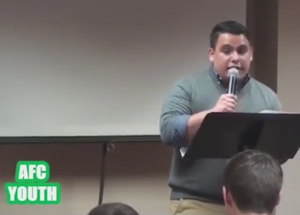
United Pentecostal Youth Leader Diego Rodriguez: Child Sex Crimes

This is Part 31 of an ongoing series on sexual abuse in the United Pentecostal Church.

Diego Antonio Rodriguez

Diego Antonio Rodriguez, born August 13, 1994, was a youth leader at Apostolic Faith Church, a United Pentecostal Church located at 3045 Airline Rd, Racine, WI where James Schumacher, born October 4, 1946, has been the pastor for decades. (new website as Michael Portman became the pastor after this article was written, though Schumacher is still there) Diego Rodriguez didn’t hold license with the UPCI, but he had preached at this church.

Diego Antonio Rodriguez

On June 11, 2015, he made his first court appearance where he was charged with one count of using a computerized communication system to facilitate a child sex crime (948.075 1r, a Class C felony) and three counts of sexual intercourse with a male child (948.09, Class A misdemeanor). He was 20 years old at the time of the crimes, while his victim, born in November 1998, was 16. This is case 2015CF000730 in Waukesha County. After his arrest, the church quickly scrubbed their website and social media of pictures and mentions of Diego. It is unknown to me how long he had been working with the youth.

Rodriguez met the boy in early 2015 through a phone application called Grindr, a gay social network. He claimed that the boy shared he was 18, but at the first sexual encounter at a home in Waukesha, he discovered he was 16. It happened two additional times at other locations after this, so Rodriguez was aware that a crime was being committed. The victim stated that he was a willing participant and was neither threatened, nor forced.

Diego Antonio Rodriguez

In April 2015, Rodriguez used Grindr to chat with another boy who was 15-years-old, though this time it was a Waukesha police detective in an undercover sex sting. The online contact continued through June, even though the detective warned him he could go to jail. He requested pictures and let him know he wanted a sexual encounter as well as a “three-way.”

On June 8, Rodriguez asked to meet at the Wendy’s restaurant on Moreland, where police arrested him while he was parked across the street. After the arrest, he admitted to knowing that what was planned was a crime. Prior to his arrest the officer posing as the boy had asked him asked if 15 was too young and if people could be arrested and Rodriguez replied that they could.

He entered an initial plea of not guilty and since his $25,000 bond was never paid, he remained imprisoned.

A trial was eventually scheduled for December 15, 2015, but was cancelled as a plea agreement was in process. On January 22, 2016, Diego Rodriguez changed his plea to that of being guilty on the first count of the charges, which was the felony of using Grindr to facilitate a child sex crime. The three sexual intercourse misdemeanors were dismissed, but read into the court record.

Diego Antonio Rodriguez
Diego Antonio Rodriguez 11-17-22

On April 4, 2016, Judge Ralph Ramirez sentenced Diego Rodriguez to ten years, with five of those to be served in prison and five under extended supervision. He was ordered to register as a sex offender through June 3, 2040. He was to have no contact with the victim, nor was he permitted to have unsupervised contact with anyone under the age of 18. He is not allowed to have pornographic or explicit material, nor is he allowed to have a computer or anything that can access the Internet unless permission is given. He also had to submit a DNA sample and pay a few hundred dollars in court fees. Rodriguez remains incarcerated as of the writing of this article.

James Schumacher
James Schumacher

An aspect of this case which is especially troublesome is that on the Fox news report article, a person claiming to be a former member of the church alleged, “The problem is that the pastor did know that this issue existed because, in addition to members bringing rumors to the pastor, Diego himself went to him and admitted it, looking for help. The response was to sweep it under the rug, allow Diego to continue working with the youth, and intimidate everyone into silence. Dig deeper into this church’s history. This isn’t the first time this has happened there and unless someone intervenes, it won’t be the last.”

Timothy Patrick Gregory

I had already known years earlier that this wasn’t the first child sex assault case of which Pastor James E. Schumacher has been aware. There were at least two others involving Timothy Patrick Gregory, a previously convicted child sex offender who the pastor allowed to teach Sunday School. He is currently incarcerated. It was alleged that pastor James Schumacher encouraged the parents to not report Gregory and even threatened to excommunicate the family members of the victims, sisters who were ages 12 and 8 at the time of the assaults in 1997. Schumacher admitted to not doing a background check on Gregory and stated, “We are a Christian church. The Bible says we need to forget the past.” James Schumacher, like some other United Pentecostal Church ministers, failed to report these assaults to the police or Child Protective Services. Since the law in Wisconsin allows for the legal loophole of claiming clergy privilege, he was permitted to do this.

Articles:
Waukesha man, a youth leader at a church, accused of having sexual relations with teen boy – July 14, 2015 (includes video)
Police arrest church youth leader after underage sex sting – July 15, 2015 (includes video- click on the watch on mobile link)
Church leader pleads guilty to using app for child sex in Waukesha – January 26, 2016
Church leader pleads guilty to using app for child sex in Waukesha – January 29, 2016
Waukesha man, former church youth leader, gets prison for sex with minor – April 19, 2016
Wisconsin Circuit Court Access
Diego Rodriguez sex offender status

You will find a complete list of articles in this series by clicking here.

********
Shop at our Amazon store! As an Amazon Influencer, this website earns from qualifying purchases.

Click to access the login or register cheese
YouTube
YouTube
Set Youtube Channel ID
BLUESKY
Protected By
Shield Security PRO